We hope that you will find our content to be uplifting and educational. Please keep in mind that this is not a space for debate or criticism but rather a place for respect, curiosity and learning.
You are encouraged to take what you can from what we share here. If you want to know more, do not look to the contributors of this blog to teach anything beyond what we post. Seek out what feels right for you, trust the Spirit to guide you and have faith in our heavenly parents who are the givers of all pure knowledge.
Showing posts with label Imbolc/Candlemas/St Brigid's Day. Show all posts
Showing posts with label Imbolc/Candlemas/St Brigid's Day. Show all posts
Imbolc, Ostara, and Beltane are all fertility festivals. I've been thinking for the last few days about whether this is redundant, but I have concluded that it is not. Obviously sex is significant (and should be!), so it seems to warrant multiple celebrations in the year. But I think that these three sabbats honor different aspects of sexuality. To explain what I mean by that, I'll go back and briefly review some of the mythology of the God and Goddess in the wheel of the year.
At Imbolc is the wedding between the God and Goddess, and of course it includes the consummation of that marriage. On Ostara their union results in conception (of the Son God, who will be born at Yule, after the Father God dies at Samhain...of course that Son will then become the Father at the following Imbolc when he marries the Goddess...).
So here is what I see as the differences between the three sexual celebrations:
Imbolc is a celebration of marriage, of consummation, and of the sacred, vow-renewing, side of sex.
Ostara is a celebration of procreation, of conception, of birth; another awesome side of sexuality, yet also not all it can be.
And what is left for Beltane? Sex just for the fun of it! Because the pleasures of sexuality are also important.
I spent a lot of time on Feb 1 and 2 making candles (I made them from tallow we rendered ourselves from a half a cow we bought last fall). We didn't use all of them for our Imbolc Feast, but we did use five.
These are our element candles--air, earth, water, fire, and (in the center) spirit. (Underneath you can also see our Sabbat table runner.)
We had cream of cauliflower soup (for the milk and butter, and also it seemed like an appropriate seasonal vegetable), and almond-poppy seed muffins (for the seeds).
When I first told my 4-year old that we were going to turn off all the lights for dinner he got very concerned and said "but mommy, we can't do that, we have to see our food." I told him we would light so many candles that we would be able to see and he said oh, well then that would be ok. The next night, he asked if we could turn off the lights and light "so many handles" again. ☺
I have decided to name each moon this year, according to my hopes and intentions for that lunation. Last month I began with my Purification Moon, and today is the new moon of what I am calling my Vision Moon.
I've been thinking about Imbolc and Candlemas, and something that keeps coming to me is that this is a day that falls within the darkness, and yet celebrates the light that we put out into the world. Candles are an obvious metaphor, and I am reminded of Matthew 5: Ye are the light of the world. A city that is set on an hill cannot be hid. Neither do men light a candle, and put it under a bushel, but on a candlestick; and it giveth light unto all that are in the house. Let your light so shine before men, that they may see your good works, and glorify your Father which is in heaven.
Candles and light are not just a metaphor for testimony, they are also a metaphor for vision I think. For our focus. The light of one candle in a darkened room will draw the attention of all who enter. We see the flame and cannot help but go toward it. Even an infant, who does not know what the candle is, will immediately focus that direction.
The light shineth in darkness; and the darkness comprehended it not.
Even if the darkness does not comprehend the light, the light still comes, and cannot be ignored. In this month where the darkness still has hold over our earth, the little lights of our candles are standing up and being seen, and cannot be quenched.
This lunation, I will ponder and meditate on Vision: what I am focusing on, where I am going, and also what kind of light I am putting out to the world.
During this new moon, my fast (I'm planning three days) will be from the internet...so I'll see ya later. ☺
As a closing, I wanted to share this song:
Be Thou My Vision
Be Thou my Vision, O Lord of my heart;
Naught be all else to me, save that Thou art.
Thou my best Thought, by day or by night,
Waking or sleeping, Thy presence my light.
Be Thou my Wisdom, and Thou my true Word;
I ever with Thee and Thou with me, Lord;
Thou my great Father, I Thy true son;
Thou in me dwelling, and I with Thee one.
Be Thou my battle Shield, Sword for the fight;
Be Thou my Dignity, Thou my Delight;
Thou my soul’s Shelter, Thou my high Tower:
Raise Thou me heavenward, O Power of my power.
Riches I heed not, nor man’s empty praise,
Thou mine Inheritance, now and always:
Thou and Thou only, first in my heart,
High King of Heaven, my Treasure Thou art.
High King of Heaven, my victory won,
May I reach Heaven’s joys, O bright Heaven’s Sun!
Heart of my own heart, whatever befall,
Still be my Vision, O Ruler of all.
If you are unfamiliar with this psalm, and want to hear it--words and music--try this link. If you just want to hear the melody, or want something to sing along with (especially if you've adapted the words for your own purposes), here is a lovely, simple, instrumental version of it from youtube
I'm not trying to be rebellious by calling Imbolc Midwinter but for some reason Midwinter is more captivating of a concept for me. The last few days have been mainly reflective as I observe and quietly celebrate the signs of spring. Tulips and hyacinths are sending up their stems and leaves outside my apartment. On trees, I'm seeing buds of leaves, even some flowers. Its the time for singing Popcorn Popping with my children, though I've always seen the blossoms more like cotton candy than popcorn.
I've noticed how the days are getting slightly longer and the sun shines a little more brightly when it makes its appearance. The last two days I've been able to glimpse the mountains of the Olympics and Cascades on the horizon. The clear days have done wonders to aid my optimism and hope for the coming spring.
Midwinter is the mid-point between the Winter Solstice and the Spring Equinox. The Equinox is viewed as the start of spring but most people of the Northern Hemisphere recognize that the signs of spring come much earlier than the actual equinox. That is why celebrating Midwinter makes so much sense to me.
There is still the anticipation and hope for brighter days and new growth and life but its more real now. Instead of the dark of the Solstice with only the promise of the returning sun to tide us over, at Midwinter, we have seen the evidence of seasons beginning to change. Its really happening and the signs are all around us.
Midwinter is also the time for planning gardens, clearing messes, organizing, starting new. Its even where the idea of spring cleaning comes from!
This Midwinter, I'll be doing a more involved form of spring cleaning. I'm preparing our new house to move into! I've got paint in my fingernails, in my hair and even all over my feet. Today I discovered the perfect place to plant our garden and the brainstorming has begun.
This year we hope to grow in our new perfect garden space that gets full sun most of the day:
Vegetables: Tomatoes, broccoli, carrots, spinach, kale
Fruits: Strawberry and elderberry
Herbs: Echinacea, Basil and Calendula
Of course, the challenge will be to start seeds and prepare the garden plot while packing/unpacking and organizing a new house for 5 people.
Another interesting aspect of Midwinter to note is what gives Imbolc its name: "Ewe's milk." Its is the time of year when ewes (female sheep) are pregnant with their lambs and their milk begins to develop (called colostrum). In humans, colostrum generally begins to be present around the 5th month of pregnancy. I find significance in this in two ways.
First, as a breastfeeding mother, I experience a feeling of solidarity with the ewes as they grow their babies inside. I appreciate the importance of that first milk to babies' development as well as the neccesity of breastmilk as infants grow and develop. In fact, it is near Imbolc each year that I can celebrate my initiation into motherhood and the start of my own career as a lactating mother. My first child was born on January 27 and this year on Imbolc, I celebrate the milestone of lactating continuously for 4 years!
Second, Christ is known as the Lamb of God and in Latter-day Saint tradition as well as supported by scholar's investigations, it is believe that Christ was born between March and April. If one were to look at Imbolc at the time of Mary's pregnancy that her colostrum began to be present in preparation for the birth of Jesus, we could see Midwinter as a time to celebrate the coming of the Savior to the earth. We can celebrate the Christ comes to bring us goodness and light and new life at the time of year when we see light and new life all around us.
Because of all of the busyness in our lives lately, my family and I will not be able to participate in a formal ritual on the day of Midwinter (Feb 2) but we will observe in greetings and in conversation the significance of the day. Indeed, it will be a festive day as we continue our preparations with our new home.
If we are able to take a break from things and stir ourselves for a social engagement, we will attend a local Wiccan's Church for their Imbolc ritual on Saturday. Wish us luck!
Imbolc is now just over a week away (on February 2), so today's post is to share some background on the Sabbat, as well as give ideas of ways to observe it. (Please note that, as with all sabbats, the celebrations/observations traditionally begin at sundown on the night before, in this case, February 1.)
Background:
The First of February belongs to Brigid, (Brighid, Brigit, Bride,) the Celtic goddess who in later times became revered as a Christian saint. Originally, her festival on February 1 was known as Imbolc (pronounced "IM-bulk" or "EM-bowlk") or also called Oimealg, ("IM-mol'g), two names which refer to the lactation of the ewes, the flow of milk that heralds the return of the life-giving forces of spring. Later, the Catholic Church replaced this festival with Candlemas Day on February 2, which is dedicated to the Virgin Mary and features candlelight processions. The powerful figure of Brigid the Light-Bringer overlights both pagan and Christian celebrations.[source link]
Brigid is the goddess not just of fire, but also of hearth and home, smithcraft (blacksmiths, goldsmiths, etc), poetry and creation, healing, women's health, and childbirth. She is an incarnation of the Maiden form of the goddess, and our word "bride" comes from her name.
Imbolc is the time of Blessing of the seeds and consecration of agricultural tools. It marks the center point of the dark half of the year. It is the festival of the Maiden, for from this day to March 21st, it is her season to prepare for growth and renewal. Brighid's snake emerges from the womb of the Earth Mother to test the weather, (the origin of Ground Hog Day), and in many places the first Crocus flowers began to spring forth from the frozen earth. [source link]
Brigid's Wheel aka Brigit's Cross
When Ireland was Christianized, veneration of the Pagan Goddess Brigid was transformed into that of St. Brigit, said to be the human daughter of a Druid... Pagan lore was incorporated into the Christian traditions and legends associated with Her as a saint. She was associated with miracles and fertility. Into the 18th century a women's only shrine was kept to her in Kildare (meaning Church of the Oak) in Ireland. There, nineteen nuns tended Her continually burning sacred flame. An ancient song was sung to Her: "Brigid, excellent woman, sudden flame, may the bright fiery sun take us to the lasting kingdom." [source link]
According to some sources, the Celts celebrated an early version of Groundhog Day on Imbolc too – only with a serpent, singing this poem:
Thig an nathair as an toll
(The serpent will come from the hole)
la donn Bride
(on the brown day of Bride (Brighid)
Ged robh tri traighean dh’an
(though there may be three feet of snow)
Air leachd an lair
(On the surface of the ground.)
On the evening before, each family member leaves one item of clothing outside for Brigid to bless. In the morning the clothing is brought back inside, with Brigid's blessing of healing and protection (see here).
Make herbal salves, teas, or other healing things.
Make your own butter.
Read scriptures about light, the Light of Christ, candles, or fires, as well as the things they stand for (testimony, example, etc) (Matt 5 is a good place to start)
Sing hymns or other songs about light, such as Pass it On.
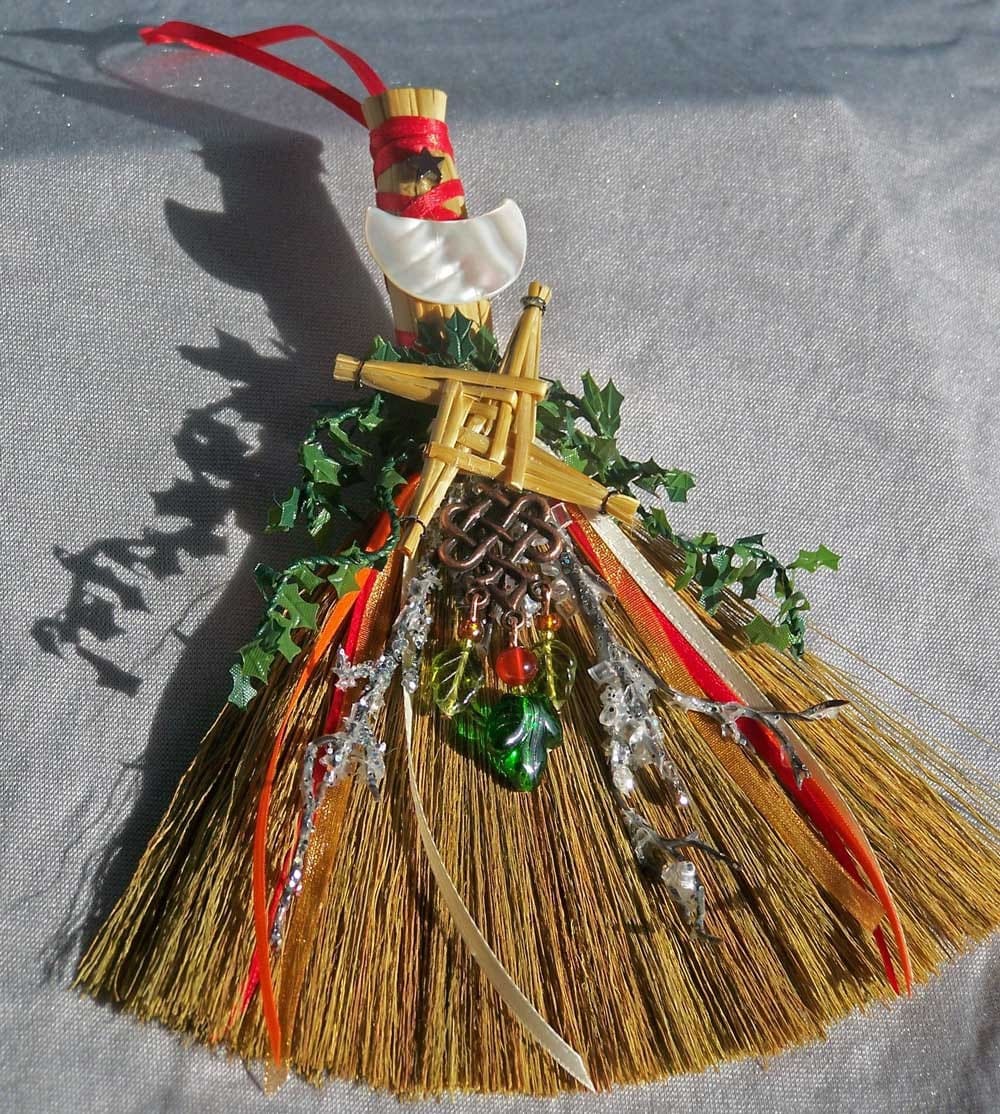
Use straw to make a Brigid's Wheel, or a broom, to hang on or above your door to bless your home
Go outside and encourage things to grow, perhaps while waving your priapic wand, and/or with a verse like this "Wake, wake, plants in the earth, / spring is a time of light and rebirth. / Hear, hear this magical sound, / and grow, grow, out of the ground."
Sweep out your home to cleanse and purify it.
Clean your fireplace/hearth and sweep out the ashes
Write or read poems
Since Brigid is the goddess over childbirth, share the birth stories of family members together
Candlemas is the day when the Catholic Church blesses their candles for the year. If you use candles in your home (especially if you use them for spiritual purposes) you might consider blessing them.